
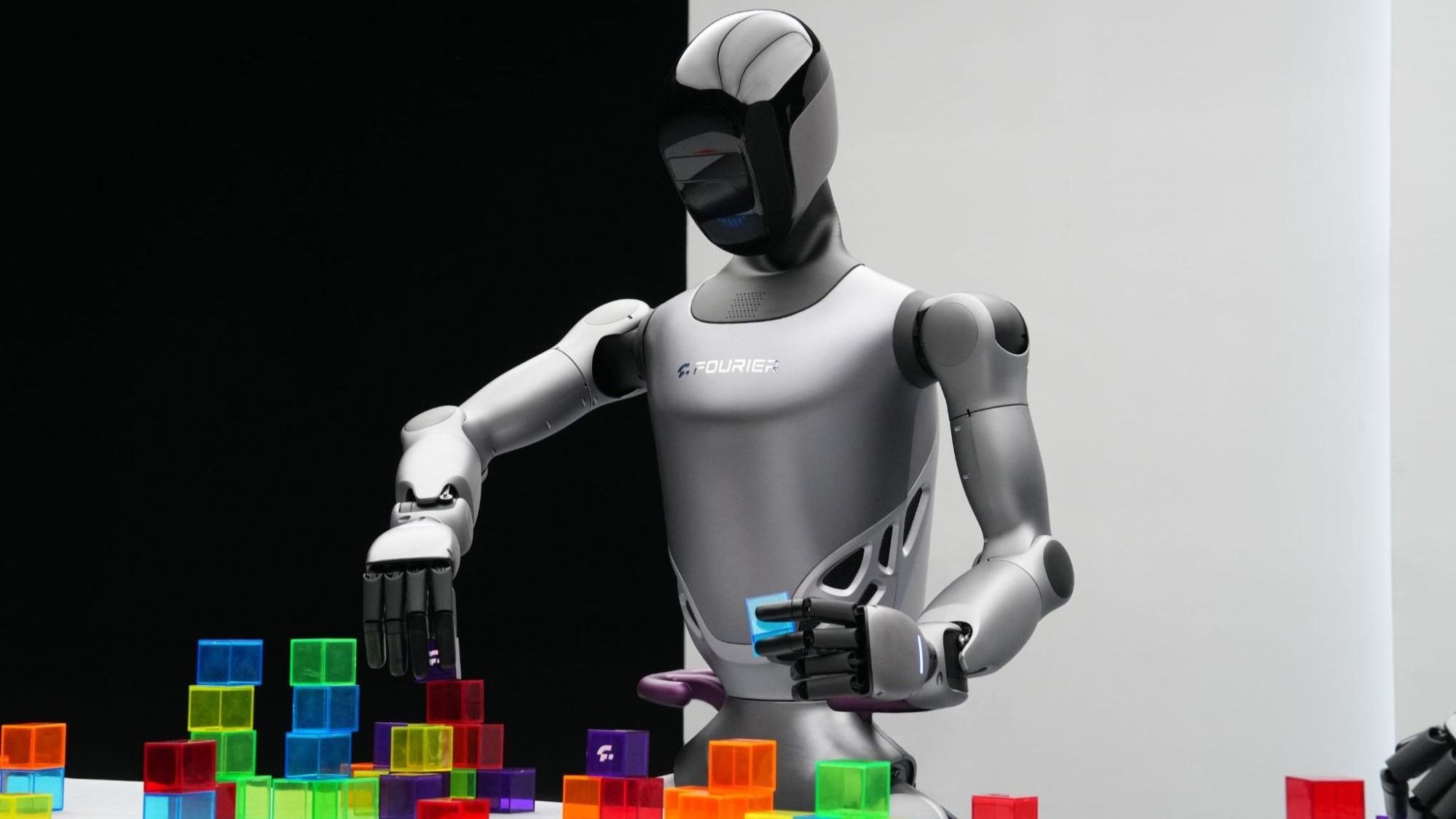
Shanghai-based Fourier partners with NVIDIA Technologies to release the GR-2 in a bid to expand its GRx humanoid robot series. Released in late September, GR-2 is the successor to the groundbreaking GR-1, known to be the world’s first mass-produced humanoid robot. Whereas GR-1 showed the real-world applications of advanced robotic agility and precision, GR-2 goes beyond the GR-1’s limits with enhanced hardware, improved adaptability, and a humanlike range of motion.
Adapting To The Real World With NVIDIA
Fourier’s GR-2 leverages NVIDIA’s cutting-edge technologies to address the challenges of training robots to operate in highly-adaptive and interactive environments. Thanks to NVIDIA’s reinforcement learning platforms Isaac Gym and its successor Isaac Lab, GR-2 took advantage of the open-source modular framework’s simplified learning processes to help the robot learn new skills to adapt to complex environments such as healthcare, manufacturing, and scientific research.
Fourier also used sim-to-real learning methods to simulate real-world scenarios, fine-tuning the GR-2 to perform complex movements such as sitting, standing, and even dancing while enjoying reduced time and costs for trial and error. With NVIDIA Isaac Gym, GR-2’s training involved multi-robot interaction simulations across different environmental conditions, giving it robust AI decision-making capabilities that reflect enhanced real-world performance.
Optimization Takes Center Stage
Optimization is the main focus of GR-2’s development and training, of which real-time inference optimization is achieved through NVIDIA’s TensorRT software development kit, parallel processing via CUDA libraries, and accelerated deep-learning framework training with the cuDNN library.
This process gave Fourier an outstanding 89% success rate after a 15-hour training session involving 3,000 iterations, making it much faster and easier to transfer their trained model to the robot’s physical controls. The improved methodology is a milestone that significantly boosts the efficiency of simulation-driven training compared to traditional techniques.
Taking A Step Forward
Fourier’s transition to NVIDIA’s improved Isaac Lab also enhanced GR-2’s training, this time with NVIDIA RTX-tiled rendering that simulated more complex scenarios.
With NVIDIA’s cutting-edge technology, Fourier enjoyed enhanced simulation accuracy while significantly reducing costs. This also paved the way for more advanced AI functionalities such as predictive analytics and language models without compromising on resources.
“The advancements we’ve achieved are pushing the boundaries of what’s possible in humanoid robotics,” said Alex Gu, CEO of Fourier. “By improving the robot’s real-time motion control and AI-driven decision-making, we are setting new standards for human-robot interaction across industries such as the service sector, academic research, and medical rehabilitation.”
The GR-2 Is A Great Leap In Robotics
Fourier’s usage of NVIDIA’s advanced technologies positioned its GR-2 robot as a key player in the future of humanoid robotics, especially in creating new robots capable of complex real-world tasks. As the GR-2 explores the limits of adaptability and interaction in the field of robotics, one could only imagine the kind of developments Fourier will create in the future.